|
|
|
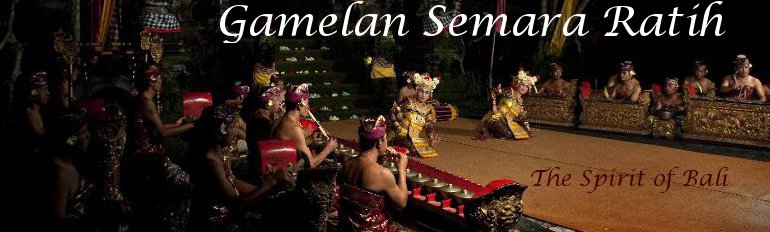
Gamelan means
“musical ensemble” in Indonesia and other parts of Southeast Asia,
where dozens of different types of gamelan are played. The
term refers either to the sets of instruments that are normally played
together or the group of players who play them. Music and dance are so
intertwined in gamelan traditions that the term gamelan often includes
dancers and musicians together.

Photo
Rio Hemli
Most gamelans consist mainly of percussion instruments, and most are tuned to five- or seven-tone scales of uneven intervals; the scales themselves, special to Indonesia, have their own beauty. The term “gamel” means to hold or wield, evoking the image of the percussionist holding the mallet, poised to play. But strings, flutes, and voice are also important parts of many types of gamelan. The instruments are made of bronze, iron, wood, or bamboo. Vertically or horizontally hanging tuned gongs are typically a major part of a gamelan.  Photo
Maurizio Rosenberg Colorni
The gamelan traditions of the islands of Java and Bali in Indonesia are the best known throughout the world. International audiences have witnessed gamelan performances at least since the nineteenth century. Gamelan troupes from Java (probably from Sunda, West Java) played at the 1889 World’s Fair in Paris and at the 1893 World's Columbian Exposition in Chicago. Compared with Balinese music, Javanese music is more likely to sound serene and contemplative, and to have a more rarified, sometimes ethereal-sounding texture. In contrast, Balinese music is more likely to feature fast, abruptly changing, dynamic playing that can reach ear-splitting loudness and usually has a denser texture and shorter repetitive cycles marked by the large gong. 
Photo
Rio Hemli
To make greater speed possible, Balinese music employs a technique called kotekan, in which each of two or more players plays only some of the notes in a pattern. The multiple parts interlock, creating a fast-moving, single composite line. The same principle is seen in the paired tunings of the instruments in the gamelan—each instrument of each pair is tuned an exact amount slightly higher or lower than its partner. The difference causes the pair to produce a shimmering, vibrating quality that cannot be obtained by a single instrument. Strokes of the large gong mark the fundamental unit of cyclical time in most gamelan music. In a Balinese gamelan most of the instruments embellish or elaborate other instruments. The lowest-pitched melody instruments play a basic structure similar to a bass line. Each layer of higher instruments embellishes the line played by the instruments below them by adding notes in between while matching the notes of the lower level. With its interlocking parts, tuned pairs of instruments, and cascading dependencies, Balinese music evokes the interdependent nature of Balinese society—every person may make a unique contribution to the society (or the performance), but it is the whole (the society or the performance) that gives meaning to those individual contributions. Much as the multiple parts played in a gamelan are locked together tightly, when dance is combined with music, the two fit together tightly as a single whole. Gamelan Bali
Photo
Rio Hemli
Musical performances are typically led by the drummers, who provide queues to the group for starting, stopping, or changing speed or loudness. The drums and certain other instruments improvise in some passages, within limits.  Photo
M. R. Colorni
Balinese gamelan is often heard in secular performances for entertainment, but it is also, perhaps primarily, a central part of religious and spiritual life in Bali. A village temple celebration or individual life-cycle ritual would be literally incomplete without certain types of prescribed music and dance required to set the stage for otherworldly spirits to descend and to provide a meditative atmosphere for prayer so that people are receptive to spiritual and religious thoughts and feelings. This shimmering sound quality, the intricate interlocking of simultaneous musical parts, the strong cyclical structure of the music, the often very fast pace of the music, the deep resonance of the large gong, the tight coupling of music and dance, the incense that wafts over the performers, and the spiritual and religious meanings attached to musical and dance performances—these conditions together create a context 
Photo
Rio Hemli
Text ©
2010 Ken Worthy Learn more about gamelan. The following books mention Gamelan Semara Ratih. Click to view or purchase.
 Gamelan Gong Kebyar: The Art of Twentieth-Century Balinese Music by Michael Tenzer  Balinese Dance, Drama and Music: A Guide to the Performing Arts of Bali  by I Wayan
Dibia and others by I Wayan
Dibia and others |
|
studio:
25 Jalan Kajeng, Ubud, Bali, Indonesia 80571 | +62 361 973277 |
+62 812 3807227 (mobile) | info@semararatih.org
|